
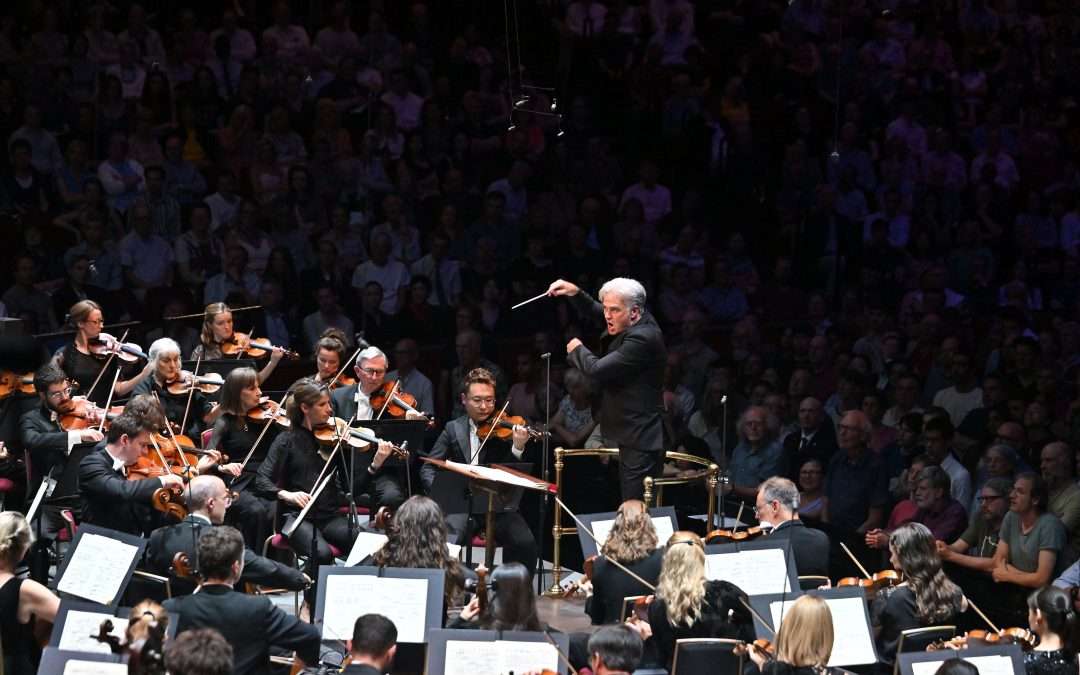
Photo, Mark Allan
Friday, August 11, 2023
Royal Albert Hall, London
Music used by Stanley Kubrick for 2001: A Space Odyssey. Ligeti’s thirty-minute Requiem is of extreme dynamics and frequencies as it explores the mysteries of the Universe through enigmatic distance, clusters of complex chords, threatening buzzing effects, and the occasional violent suggestion of catastrophe. Edward Gardner controlled the score admirably, and the balance, in all its demands, seemed prepared to the nth degree, choral and orchestral, to allow the music its fullest and strangest (if not cinematic!) communication. (Requiem last came my way from Berlin, https://www.colinscolumn.com/berliner-philharmoniker-matthias-pintscher-conducts-bernd-alois-zimmermann-ligeti-with-amihai-grosz-playing-martinus-rhapsody-concerto-for-viola-and-orchestra-live-digital-concert-hall-webcast/.)
The Prom’s part two opened with the Edvard Grieg Kor alone high in the Gallery, Gardner remaining on the podium, for further Ligeti, Lux aeterna, the singers phoning in their distant signals to him, if at times louder than pianissimo, less secretively lontano than it might have been, as broadcast.
From a cappella to full orchestral. Gardner already has a Proms Zarathustra credit (during the 2016 season with the National Youth Orchestra). Following the superlatives chucked at the Strauss by R3 presenter Georgia Mann (see related readers’ comments here, https://www.colinscolumn.com/bbc-proms-2023-prom-30-sinfonia-of-london-john-wilson-conducts-lili-boulanger-william-walton-with-alim-beisembayev-playing-rachmaninovs-second-piano-concerto-live-on-bbc-radio-3/), who was also at-odds with her colleagues in pronouncing LPO leader Pieter Schoeman’s surname (invariably ‘skooman’), Gardner conducted a rather subdued, sometimes chaste, if suitably philosophical account of this Nietzsche-inspired symphonic poem, ‘symphonic’ being the hallmark of Gardner’s approach, the LPO finely honed in response, although greater tumult was needed for the ‘Midnight Bell’ episode, the instrument itself (borrowed from the Liverpool Phil), while audible enough, lacked cut-through clangour. Come the wasteland of the closing bars, the highs and lows of the scoring returned us to Ligeti…
Jennifer France soprano
Clare Presland mezzo-soprano
Edvard Grieg Kor Håkon Matti Skrede chorus-master
London Philharmonic Choir Neville Creed chorus-master
Royal Northern College of Music Chamber Choir Stuart Overington chorus-master
London Philharmonic Orchestra Pieter Schoeman leader
Wow, you should have been in the Hall, Colin. The bell E was huge, cutting right through the orchestral tutti, superbly. I must listen to the broadcast and compare. In the hall the best I have heard for a longtime. I agree with your comments about EG’s approach, though.
I have now been able to listen (which i do on very high end equipment) to the Strauss on BBC Sounds (the Ligeti awaits) from which, first, i now understand Colin’s comment about the bell which was most dramatic in the Hall. The BBC broadcast, whilst of very wide dynamic range, is often of quite veiled quality in anything below the level of mezzoforte, to the point of inaudibility as it gets quieter- the horns are frequently more recessed than they appeared in the hall. The more complex textures do not come over as clearly as they should have done, either. There was far more ‘body’ in the sound throughout that the BBC gave Vladimir Jurowsky in 2013 for the same work, to which i have just listened again to check,- for a start, back in 2013, the pedal C opening on the organ was properly audible, it was barely so last night.
It is a pity that the BBC engineers did not do the fine performance justice
I totally agree about the OTT Georgia Mann.