
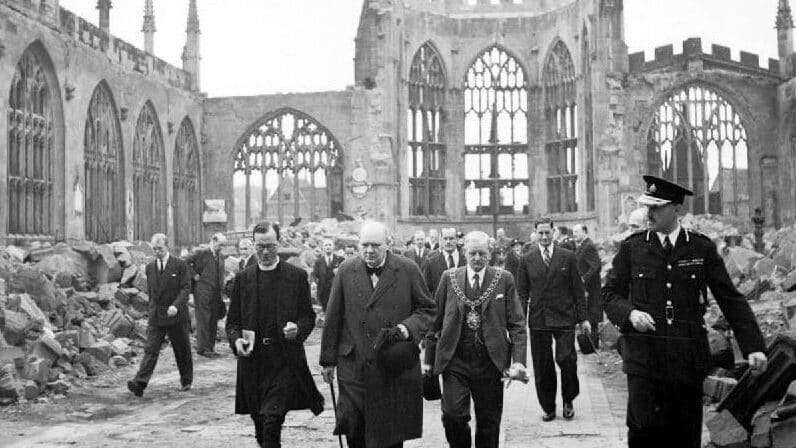
Coventry Cathedral in ruins, World War II
Saturday, August 17, 2024
Royal Albert Hall, London
May 30, 1962, in the new Coventry Cathedral, the premiere of Benjamin Britten’s War Requiem, the composer conducting the chamber orchestra, Meredith Davies the CBSO, the male soloists, Peter Pears and Dietrich Fischer-Dieskau, in place (for Wilfred Owen’s WWI poetry) but not Galina Vishnevskaya, Heather Harper the replacement (singing the Latin Mass for the Dead texts with the adult chorus), although she did manage to leave Russia to take part in Decca’s recording sessions. Following the opening, with ominous tolling bell, there’s another choir, of boys’ voices, soon to be heard, ethereal, from afar, chamber organ as accompaniment – it was clear that Antonio Pappano was exploiting the venue’s space and spaces, and also a wide dynamic range, witness the start of Dies irae’, the main chorus unleashed, prefaced by stunning brass-playing. From there, unified by Pappano conducting both orchestras (the smaller one to the conductor’s right), with the male soloists, there was a persuasive ebb and flow, and integration, to this deeply considered, sadly so relevant for today, performance, of drama and reflection, the combined BBC Symphony & London Symphony choruses wonderfully communicative at whatever volume as well as stretching every sinew when an extra roof-raising increase in power was needed. Perhaps Will Liverman lacked the last degree of vocal weight and gravitas, if not sincerity, overshadowed by Allan Clayton, whose “One ever hangs” (‘Agnus Dei’) was especially poignant, his Britten-esque credentials established sometime ago, and Natalya Romaniw compelled in everything she did. As for the final section, ‘Libera me’, it climaxed as if from Hell, spitting deadly fire, making Owen’s ‘Strange Meeting’ – an exchange between an English soldier and a German one, Liverman making much of the latter’s “I am the enemy you killed, my friend” – all the more chilling, with eloquent oboe solos, and the subsequent “Let us sleep now”, consolatory and reconciliatory, if leaving a question mark, a void. Throughout this increasingly engrossing account (a few seconds short of eighty minutes) the LSO was in magnificent form for Tony Pappano, soon to be Chief Conductor of the Barbican-based orchestra.
Natalya Romaniw (soprano)
Allan Clayton (tenor)
Will Liverman (baritone)
Tiffin Boys’ Choir
BBC Symphony Chorus
London Symphony Chorus
“[War Requiem is] a work of hope that emerged from the ashes of destruction. Benjamin Britten was moved by the bombing of Coventry during the Second World War to write his monumental War Requiem, a work that pits contrasting musical ensembles against one another as the chilling innocence of boys’ voices meets the outspoken, acerbic protests of soldiers and massed choirs expressing suffering and deliverance. Never has this tense, angry and cautiously optimistic work seemed more relevant since its first performance 62 years ago.“
https://www.bbc.co.uk/programmes/m0021xzm