
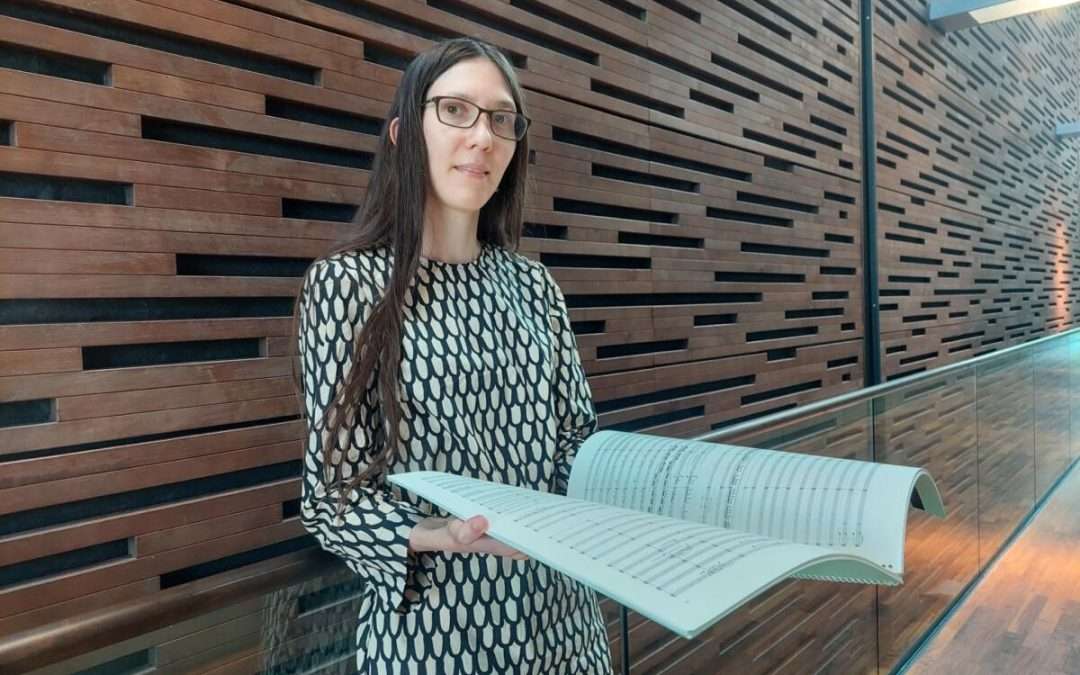
Lara Poe
Sunday, August 25, 2024
Royal Albert Hall, London
The students of the Royal College of Music (London) and the Sibelius Academy (Helsinki) came together, Sakari Oramo conducting, and an apt choice of repertoire, opening with Sibelius’s The Wood Nymph, a rarity (from the 1890s albeit not published until 2006), if distinctively by him.
https://www.sibelius.info/english/musiikki/ork_muita_metsanhaltijatar.htm
A brilliant, majestic, expressive and dramatic piece, lasting twenty or so minutes, at times a cousin to Sibelius’s En saga and his Karelia music, The Wood Nymph here received a superb performance, something of a revelation.
Lara Poe’s Laulut maaseudulta (composed to a BBC commission) made a big and rather wonderful first impression with the versatile and virtuoso soprano Anu Komsi.
“Lara Poe started working on Laulut Maaseudulta in the autumn of 2023, but most of the creative process happened in the spring of 2024. The song cycle is based on her family’s history. It reflects her grandmother’s upbringing on a farm in Kauklahti, Espoo, Finland in the 1930s-1940s – and how it was affected by the Second World War. ‘My grandmother Tidi reminisces a lot about her childhood on this farm. I recorded and transcribed my conversations with her, picked a few stories and started transforming them into song texts. Several of the songs talk about the cows and horses she had on the farm and explore our relationship with animals. Some tell stories of Finnish people who passed the farm on their way from Karelia as they were escaping the war.’“
Laulut maaseudulta is an inviting score, painterly and involving, and a tour de force for the singer. Komsi was in fabulous form, making music out of the technical challenges, not least the stratospheric ones, scenery and emotions to the fore as expressed in the composer’s grandmother’s Finnish language, colourfully scored.
Postscript: There have been more than enough new-music duds this Proms season – my lips are sealed though as to what and only two were written about here – so Laulut maaseudulta restores faith in what a composer can do today without contriving to be liked. Keen to listen again.
Following the interval, Oramo tore into ‘Mars’ to open Holst’s The Planets – “let slip the dogs of war” – and overall led a fresh-faced account full of personality, played impressively, speaking volumes for the students’ skills and musicianship, Oramo’s leadership and interpretative abilities, and the originality of the music itself, which by the end, via a noble ‘Jupiter’ hymn, sported ethereal upper voices nicely distanced then fading to nothingness, courtesy of the RCM Chamber Choir. This concert now transfers to the Helsinki Festival.
https://www.bbc.co.uk/programmes/m00224v9
A curious new work.
More a virtuoso vehicle for the magnificent Anu Komsi than any intrinsic value.
It was too long for the audience, bereft of English subtitles .
Memories of Robin Holloway in his pomp, so full marks for that.
Lots of useful harmonic moments and my attention reflected on the use of vocal range which seemed to vary from Pierrot lunaire to Luonnotar.
So not too bad.
The Wood Nymph early on conjured up early minimalist tendencies later refined by Phillip Glass etc.
No reference to the usual Nature influence rather a full blown exposure to marvellous sensual/sexual feelings in the raw.
It proves Sibelius was highly sexed at this early period in his life.
Marvellous. Deserves more performances. Thanks Proms for bringing it to the attention of millions of ears.
I agree, Colin, with the quality of the performances although the Lara Poe was wasted on me.
Again, i write about the quality of the broadcast, although this one was a bit better than the shocker BBC produced for the RPO under Petrenko. But here the wind balances often resembled the highlighting in the bad old CBS recording days. The horns and brass were often subsume to the recess ‘back yonder’! More importantly, there was no bottom end to the Orchestra. In the two great, long crescendos which built up to the end of the first and last part of the Wood Nymph , the underpinning tympani and rolling bass drum went for nothing. I was troubled that it might be my sound system which was letting the BBC down but, no, I went to Osmo Vanska’s recording with his Lahti Orchestra which restored my faith wonderfully. This is happening too much, the BBC can and used to do so much better.
A fine Planets although shame on Oramo for the emphasis on the first and third beats of the strings 5/4 at the beginning of Mars. Boult and Handley would have turned in their graves, particularly the latter who used to go on about it!