
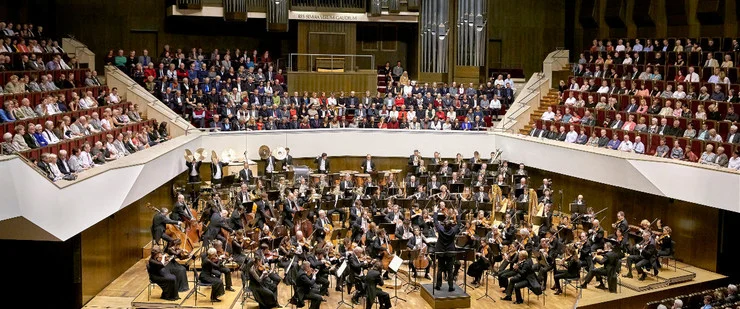
Neue Gewandhaus
Tuesday, August 26, 2025
Royal Albert Hall, London
This one looked curious on paper. After all, the centuries-established Leipzig Gewandhaus Orchestra has little association with Sibelius’s music, Andris Nelsons not much more, if a few things with his other titled directorship, Boston, including Symphony Seven, Luonnotar, and an own-label Sibelius Two. Bruckner has been central to his time in Leipzig, documented on DG, ditto for Shostakovich in Boston, with Mahler most places. Furthermore, Sibelius’s Second Symphony is the usual choice from the Seven.
Opening any concert with Arvo Pärt’s Cantus in memoriam Benjamin Britten is unsatisfactory – irrespective of whether your point of view finds it tedious, despite its brevity and sincerity, or sublime – while, here, it would have preceded the Sibelius quite well, allowing music by a Leipzig-associated composer to start the evening, a Mendelssohn overture for example, such as for Ruy Blas. If nothing else Pärt’s Cantus showcased the Leipzig strings (and the person tolling the bell, the only percussion of the night, timpani aside) to bring sensitivity and radiance. In Dvořák’s Violin Concerto, Isabelle Faust, replacing Hilary Hahn, was fiery and intimate in a work that is part and parcel of her repertoire, witness her security, intensity, eloquence (slow movement) and vitality (Finale), the Leipzigers’ stylish/interactive song and dance accompaniment attuned to composer and soloist. Faust offered a contemplative encore, by Naples-born Nicola Matteis (1650–1713), a violinist who came to London. Sibelius’s Second was measured, flexible, and noble-sounding, without suggesting Nelsons was involved in the work’s sentiments to the nth degree for all that the playing had much distinction. The Scherzo was windswept, the Trio languorous, and the Finale not without ardour if wholesomely it fell a bit short. Encore? Nope.
https://www.bbc.co.uk/programmes/m002h8x7