

Photo, BBC/Chris Christodoulou
REVIEWED FROM LIVE RELAY ON BBC RADIO 3
Saturday, August 29, 2026
Royal Albert Hall, London
Maybe it was meant to be Klaus Mäkelä conducting but he had stepped down as Chief Conductor of the Oslo Phil at the end of the season just gone, a year early, with Chicago and the Concertgebouw in his headlights, and an au revoir due for Orchestre de Paris. Anyway Mirga G-T got this Proms date. I wondered if the Norwegian ensemble would pay tribute to King Harald V whose death was announced yesterday aged 89, with something like Grieg’s The Last Spring. I wasn’t far off, we got the Norwegian National Anthem, seeming suitably solemn on this occasion, received, as requested, by silence.
The programme proper began with Øyvind Torvund’s Forest Morning (2019), incorporating an electronic soundtrack, of birdsong and urban jottings, not unattractive if limited in its timbre palette. Composer present.
Stravinsky’s Violin Concerto (1931), in four shortish if incident-packed movements – ‘Toccata’-‘Aria 1’-‘Aria 2’-‘Capriccio’ – for Samuel Dushkin (see below) is perhaps best described as neo-Baroque, crisp of counterpoint and resolute of rhythm, the violin attracting numerous partners within the orchestra, with the two middle ‘Aria’ movements yielding the most soulfulness. The self-styled PatKop has a tendency to be wilful. Here she was approximate, with tone that could be acerbic (like Bach in ‘period’ style) and phrasing that went against Stravinsky’s meticulous craft, giving rise to orchestra-togetherness issues. PatKop offered a display of violin pyrotechnics that was dangerous if committed, a challenge to conductor and orchestra, accepted and undertaken, and while it was nerve-shredding it was also a high-wire act without a safety net, not particularly illuminating of this Concerto but a compelling example of recreative musicians taking risks and getting away with it, just. For an encore PatKop played, as she has quite a few times, her own cadenza for the Stravinsky (Baroque composers didn’t write these), not for inclusion in the tight-knit Concerto, but a showy if stylishly-related extra, JSB in its veins.
Conductor-compiled selections from Prokofiev’s extensive ballet score for Romeo and Juliet tend to be unsatisfactory, especially when the composer made three Suites, the movements of which could be played in the order they appear in the complete work. As in April in Berlin (below) Mirga made well-balanced choices, played them attacca (well, not quite, the clappers found a way in, before and after a disjointed ‘Death of Tybalt’; Celibidache/LSO, April ’78, different league, below), and ended at the deeply moving/transcending end, presenting them with theatrical force and passion or with much heartfelt intensity for the lovers’ tragedy.
The Oslonians’ encore was a delight, something Radio 2ish, 1950s’ cinema interlude, speckled with ondes-like daubs … it was further Øyvind Torvund by the title of Starry Night, this version just five days old.
https://www.bbc.co.uk/programmes/m0030lcl
Orchestre Lamoureux conducted by the composer; recorded 1935.
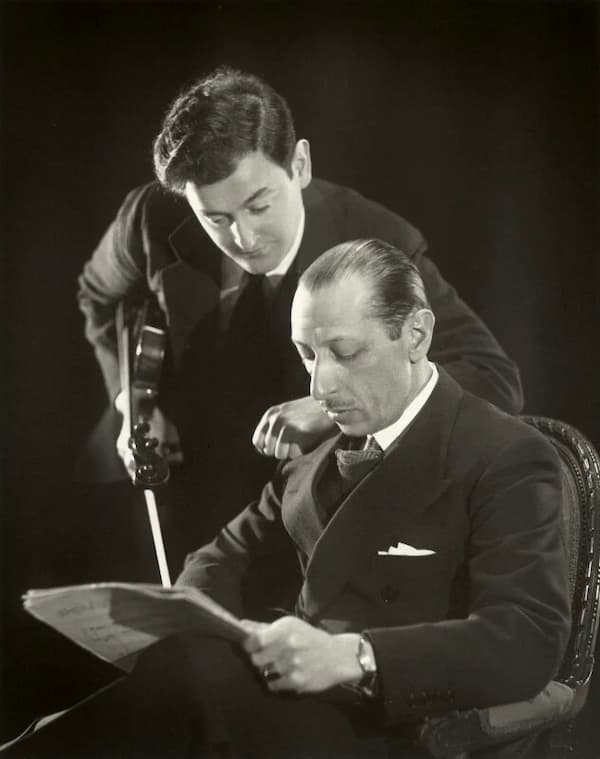
Samuel Dushkin (1891-1976) with Stravinsky.