

Saturday, July 11, 2026
Odeonsplatz, Munich
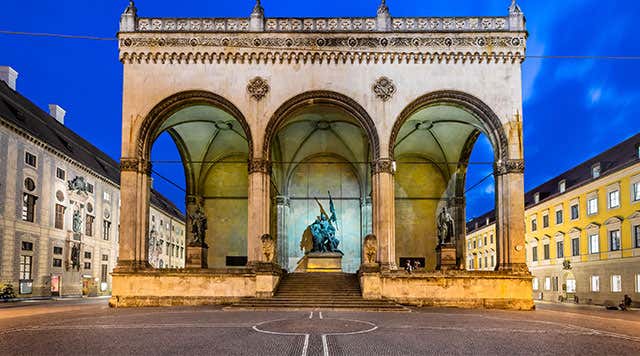
Among the activities in and around the Hitler-associated Odeonsplatz is a “Third Reich Walking Tour”. If visiting Munich, it probably has to be a must-do. However, on this Saturday evening the Bavarian Radio Symphony Orchestra performed George Gershwin’s music in the open air on a temporary stage erected in front of the monument photoed below to a capacity crowd. The Overture to Let ‘Em Eat Cake isn’t stuffed full of hit tunes; rather it has an edge and a contrasting smoothness, catered for by Sir Simon without elevating the piece beyond its starter function. Then the Concerto in F, with Kirill Gerstein departing from the score on his first entry, for a cadenza – probably the composer did similarly (or would have done) – for an overall performance that went blithely through melody and raced through quick passages yet was somewhat laborious in the middle movement, Gerstein going off to a place of his own creation. Anyone new to this work through this questionable rendition now getting a recording by, say, Grimaud, Ohlsson, Previn (three) or Siegel is in for a surprise. ‘I got rhythm’ was Gerstein’s encore, the tune buried within a welter of notes and a foot hard on the accelerator.
Following a tedious thirty-minute interval, Robert Russell Bennett’s superb Porgy and Bess: A Symphonic Picture, 1942, composed for Fritz Reiner and Pittsburgh, a brilliant Technicolor confection given love and luxury by the BRSO and Rattle, now with playing true to this ensemble’s reputation, ‘Summertime’ especially evocative at this expansive tempo, with other numbers ideally judged, not least when storm cones get hoisted, the named pair voluptuously etched by strings, and a tutti energy and a relish of detail, including banjo and saxophones, that was high-kickin’ and sophisticated without losing the essential humanity of everyday folks’ circumstances. An American in Paris was no-less colourful, zesty and contemplative, big-band uproarious (flamboyant nightclub trumpet solo), all in place from when I was a lad absorbing its ‘whole nine yards’ – meaning Rattle didn’t use the recent Critical Edition, except he did in the final few minutes where ‘new’ material is introduced. Dark now in München, 10:30, if no problem for the BRSO members to Strike Up the Band, suggesting they could have played all night.
Recorded 1945. Pittsburgh.
Concerto in F: Yes, lots of young soloists are “carving their initials” in the GG piano-plus-orchestra pieces; what do audiences gain? The 30-minute interval (they’ve gotten longer in the U.S. as well): 60-80-100 years ago, the American orchestra programs listed them as ten or fifteen minutes. AIP “Critical Edition”–no one has offered proof that, during Gershwin’s last year (when he was guest-conducting AIP and playing RIB and the Concerto) the hosting orchestras were using anything other than the published, Campbell-Watson-edited edition of AIP. These latest GCE offerings help extend the Gershwin copyrights; I suppose they represent the “first version” or “first draft” of the pieces, but it’s a stretch to call that a “composer’s original intent” we should now elevate. There’s quite a story behind the “Symphonic Picture”; when I wrote it up for Musical Quarterly years ago, I listened to its 30 commercial recordings, and what I recommend to conductors is Reiner’s, which you posted. He never treats it as “pops” material, and brings it in at its 24-minute target. Both he and RRB were very close friends of GG; Reiner had been GG’s hoped-for conductor of “Porgy and Bess” in 1935, but was unavailable.