

Franck Ollu
Friday, October 30, 2026
Herkulessaal, Munich
An ambitious concert, add at least another half to that, two premieres and a big, complex Beethoven-inspired piece by Hans Zender, all involving much study and preparation for Franck Ollu, and no doubt hard-working rehearsals with the Bavarian Radio Symphony Orchestra.
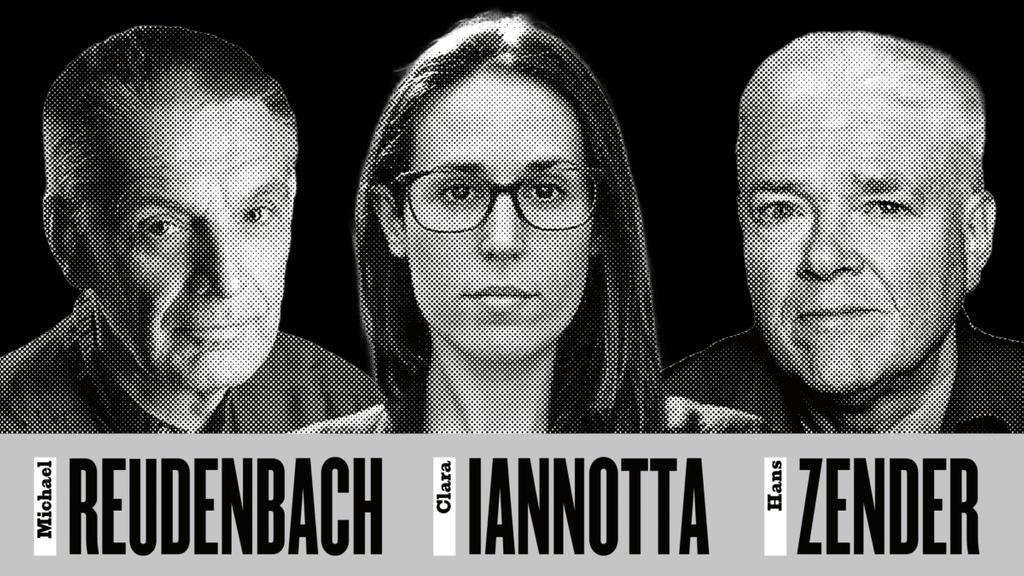
Michael Reudenbach’s new score mixes sound and anticipatory silence, dominated by a five-note motif first heard as witticisms for trumpets before spreading through the orchestra added to by stuttering mechanical figures, sustained string chords and quirky rhythms to continue the development, giving the allusion of travelling while standing still, the music eventually extinguishing itself, although there were several points in the nearly twenty minutes where the piece could have finished. At times I was reminded of ‘The Twittering Machine’ from Gunther Schuller’s Paul Klee Studies.
As for Clara Iannotta’s similar-length violin concerto, it suggested a sci-fi soundtrack. Heavy on electronics, at no point was a real instrument discernible by natural identification, not even Carolin Widmann’s violin, presumably manipulated for the quite prominent coarse textures, although whether the sounds are notated or will be different performance to performance, I am not sure. Certainly a high degree of drama was generated.
33 Veränderungen über 33 Veränderungen (2011/19) by Hans Zender (1936-2019) was the highlight, a “composed interpretation” of Beethoven’s Opus 120, the Diabelli Variations, if essentially a wacky, weird, and at times, wonderful orchestration – including percussion, harp and accordion – of Beethoven’s piano original, Zender especially admiring of Alfred Brendel’s reading(s) of it (understandable, I recall a London account years ago by Brendel that was mesmerising). Maybe Zender overdoes the skittishness but there’s a serious side to his undertaking, reimagining the music in unexpected connections (one Variation – all are recognisable, as is Diabelli’s spawning ditty – reminding of Aaron Copland’s ‘Short’ Symphony), and a trumpet solo elsewhere has an import all its own, with the Don Giovanni section employing the full weight of the Commendatore. This fifty-seven-minute performance was focussed and committed, shedding new light on Beethoven’s achievement and how it can step outside its Fach into surprising territory through Zender’s experience and imagination.
Michael Reudenbach
“fast dasselbe”, music for orchestra
commissioned by BR’s musica viva series
world premiere
Clara Iannotta
“sand like gold-leaf in smithereens” concerto for violin, orchestra and electronics
world premiere
Interval
Hans Zender
“33 Veränderungen über 33 Veränderungen”, eine komponierte Interpretation von Beethovens “Diabelli-Variationen”
“The idea that works of art are to be understood not only as original creations but also as part of an aesthetic dialogue unfolding across centuries lies at the heart of Michael Reudenbach’s orchestral work fast dasselbe [“almost the same”] – musical figures with ambiguous identities. Sand like gold-leaf in smithereens is the title of Clara Iannotta’s new concerto for violin and orchestra. Written for the violinist Carolin Widmann, the work allows the composer and the soloist to jointly explore the violin in new ways. With 33 Veränderungen über 33 Veränderungen [“33 Variations on 33 Variations”], Hans Zender has created a classic based on a classic: a re-interpretation of Beethoven’s Diabelli Variations that is virtually unsurpassed in compositional ingenuity. Conducted by Franck Ollu, this performance will serve as a bridge to the upcoming Beethoven Year in 2027.” [BR]
I am not convinced that the image of Zender is him!