
Tuesday, August 13, 2024
Royal Albert Hall, London
On his sixty-fifth birthday, Martyn Brabbins conducted this mouth-watering London-themed programme, opening with Elgar’s musical snapshot of the capital in 1900, Cockaigne Overture (In London Town), jaunty, exuberant and, following the military band episode, poignant, before ending grandly, the ad lib removed from the organ part on this occasion. All finely done, and there’s a military band aspect to Holst’s Hammersmith (1930), the original version being scored for such forces, later orchestrated, to describe a part of West London that Holst knew (he taught there at St Paul’s Girls’ School). This ‘Prelude and Scherzo’ seems dark, even a little sinister, until it bustles with early-morning life, albeit angularly and (maybe) troubled. It’s certainly a fascinating work that goes beyond obvious scenery – and also The Planets – splendidly revealed here by a contrapuntally exacting Brabbins and the unerringly responsive BBCSO (Stephen Bryant, leader).
Dublin-born Sir Charles Villiers Stanford’s London association includes being a longtime Professor at the Royal College of Music (just across the road from the Albert Hall). Christopher Maltman sang three of Stanford’s six Songs of Faith, words by Walt Whitman, magnificent settings done proud by the baritone, followed by a nod to the composer’s Irish roots with something enchanting. (Stanford died one-hundred years ago.)
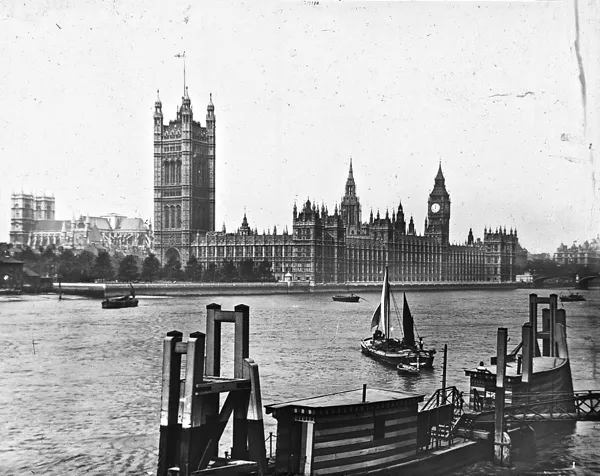
Following the interval, like Holst a pupil of Stanford’s, Vaughan Williams’s A London Symphony (Symphony No.2; 1914/1920/1936) heard here via its intermediary score (revised 1918 to become the first published version, 1920), as recorded by Brabbins and the BBCSO to launch their now-complete VW Symphony Cycle for Hyperion. For example, the 1920 publication includes a passage in the second movement that the composer would excise in his final revision, and other changes. It’s an altogether special piece, taking the listener beyond the named place despite the ‘local’ colour (Big Ben, street cries, folk and popular song), deeply affecting music (such as the luminous slow movement graced by a lovely cor anglais solo) that hit the spot in every particular during this Prom performance, such as a perfectly paced (not rushed) Scherzo and (not prefaced by clapping for once) a Finale that was full-measured in terms of London’s grimier/poverty side with a bitter, grinding climax (‘solo’ tam-tam in the mix) before turning full-circle to the passing Thames in preparation for a new day … and to a significant audience silence.
Martyn Brabbins returns to the Proms on August 30 for a concert originally designed for Andrew Davis. Stravinsky and Steve Reich as intended, with music by Tippett and Elgar now added as a tribute to Sir Andrew from composers that were signatures for him as they are for Brabbins.
Charles Villiers Stanford: Songs of Faith, Op.97
– ‘To the Soul’
– ‘Tears’
– ‘Joy, shipmate, joy!’
The Fairy Lough
https://www.bbc.co.uk/programmes/m0021ptr
https://www.hyperion-records.co.uk/dc.asp?dc=D_CDA68190
https://www.hyperion-records.co.uk/dc.asp?dc=D_CDA67065
Hello, again, Colin. A better broadcast notwithstanding a few odd balances but you say ‘ the ad lib removed from the organ part on this occasion..’. I read this as saying the organ was omitted. It was very much there in the depths although not hugely prominent. Loved the review. Wonderful Tam-tam at climax of last movement, as it should be marked ‘solo’ fff over three and a half bars!
No Laurie, the organ part is marked ad lib I believe, and was indeed included here, removing the ad lib option. Colin
Ah, Colin, I read your meaning incorrectly.
I have now just listened to the whole VW symphony. I so agree with what you write about it. MB gets that climax in the last movement to complete perfection for me. So many conductors ignore the tam-tam marking. Norrington gets it very right. With Haitink and LPO it is not there at all. MB fills the back of the Or Hester’s with the huge wish of sound just brilliantly. A small point but it is such a great moment preceding the final quiet coda which, thankfully, the BBC engineers left alone
By which I mean the ‘back of the orchestra with the huge wash of sound!’!