
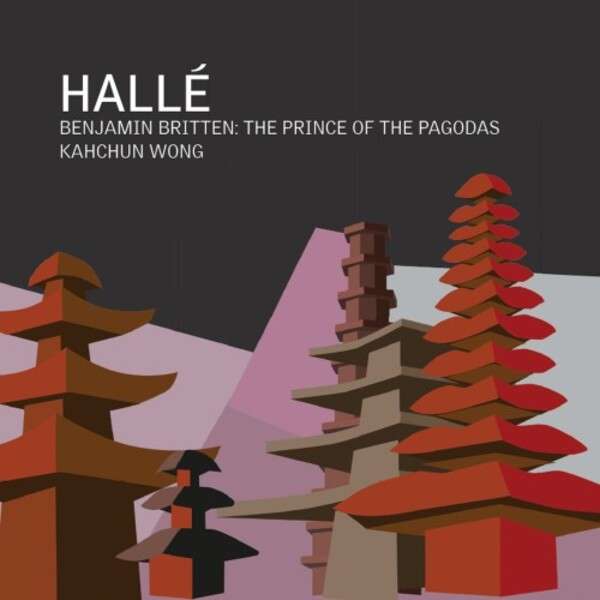
“An Emperor must decide which of his two daughters should inherit the throne, and he chooses the evil older sister Belle Epine over the young and beautiful Belle Rose. Belle Rose is taken by magical flying frogs to Pagoda Land, and meets the Prince of Pagoda Land who is in the guise of a Salamander. Belle Rose and the Prince return to the land of her father and confront her evil sister, in the end driving her away.“
Benjamin Britten’s magical score, complementing John Cranko’s choreography, was introduced on the first day of 1957 at the Royal Opera House, the composer conducting, and recorded for Decca, with a few incidental cuts, subsequently opened up in Oliver Knussen’s version, and now in this fresh-sounding and vibrant two-hour-ten-minute Hallé take, for which Kahchun Wong – Mark Elder’s successor in Manchester – has absorbed every detail (no doubt aided by Colin Matthews’s artistic advice) and conducts with relish, finding the orchestra in top form, playing with enthusiasm. Britten’s Pagodas music is hugely enjoyable, vividly colourful and characterised, full of variety, and inclusive of Balinese gamelan aspects; he had visited Bali during composition. There are also correspondences with the Stravinsky of Apollon musagète, Le baiser de la fée, and Scènes de ballet. Collectors new to this tuneful, exhilarating and ravishing opus can start here with confidence. CD HLD 7565 (with excellent presentation – introductory essay and a synopsis – and sound, Steve Portnoi) is released on November 1.
I was sent this set a couple of weeks ago. I was working at Boosey & Hawkes in late 1956 when Britten was hurrying to finish the score, which came in in dribbles and drabs – he was getting up at before 6am every morning to finish it. I found the orchestration utterly compelling and was very disappointed at the time that the work did not make the impact it deserved to do. I suspect that was because Cranko did not have the music long enough to create truly meaningful choreography.
Pagodas is a major score in Britten’s output but is invariably overlooked, presumably by those writers who take his own put-down of the music as Gospel – but I think (and have always felt) it is a neglected masterpiece of ballet, exceptionally well played in this new set. I pray this will lead to a complete re-evaluation of the work – but of course it dated from a period, seventy years ago, when ballet was very different from what it has now become, in terms of choreographic understanding and re-creativity – especially of a major new score by a great composer: trouble is, there are not that many great composers around today compared with the 1950s, when you could rattle more than a dozen names off the top of your head. A Ph.D thesis on Pagodas might be a start.